

In this article
You know your pour cost to the cent. You know your food cost to the cent. Ask an owner what a card payment actually costs them, and the answer is almost always one rounded figure — "about one and a half percent" — with nobody ever having unpacked where that percent actually goes. That's strange, because unlike a round on the house, this cost is right there on a statement. Nobody has ever opened it.
Every time a guest taps their card, that single percentage is really being split four ways: the guest's own bank, the card network, your payment processor, and sometimes a separate gateway or terminal provider. Three of those four slices are a business decision made by your own supplier. One of them has been fixed by law across the whole EU since 2015, capped at 0.2–0.3%.
Most owners who do know about that legal cap assume it's their rate. It's only the smallest of the four slices. The rest — the network fee, your processor's own margin, and the terminal cost — add up to the number you actually pay, and that number is never handed to you as four separate lines. You get one percentage, and one percentage reads as something you can't do anything about.
That's exactly why this guide exists. Below, we unpack those four layers, show which one is fixed and which are negotiable, and put cash next to them — because notes and coins feel free right up until you count the time it takes someone to sort, secure and bank them. At the bottom, plug in your own revenue, your own rate and your own cash-handling time, and you'll get a real annual figure, plus what a lower rate would actually be worth.
Everything runs in your own browser — nothing is sent anywhere and nothing is stored. The figures in this article are a benchmark for independently run European restaurants; your own contract, your revenue mix and your negotiating position are the final word.
Why almost nobody knows this number
A card rate is never handed to you as a sum — it's sold to you as one percentage, on a contract you usually sign during the busiest week of opening, alongside a POS system, a lease and a licence. "One and a half percent" sounds neither negotiable nor confusing; it just sounds like the price of taking cards, the way VAT is the price of existing. Almost nobody asks what's actually inside that percentage, for the same reason almost nobody reads the small print on an energy contract in full: it feels like a fixed fact, not a dial you can turn.
On top of that, the party that sells you the rate is also the party that sets it. Your payment processor has no incentive to explain that three-quarters of what you pay is their own margin rather than a fee they're passing on — quite the opposite, one blended percentage hides that distinction very well. Ask for an interchange-plus breakdown (see step 3) and most processors only produce one once you explicitly ask.
And the amount itself is small enough per transaction to never register. An €80 table costs you about €1.52 at a 1.9% rate — too little to argue over, too much to ignore once you add up a year of card revenue. It's exactly the same pattern as the round on the house: every single decision is too small to discuss, and nobody ever adds up the total.
The 7 numbers behind your card rate
They run in the order they build on each other: from the four layers that make up your rate, to the conversation you have with your processor afterwards.
1. Your "rate" is four layers, not one
What shows up on your statement as "card fees 1.9%" is really the sum of four separate costs, each of which goes to a different party. The interchange fee goes to the bank that issued your guest's card, and in the EU it's capped by law at 0.2% for a consumer debit card and 0.3% for a consumer credit card. The scheme fee goes to the card network itself (Visa, Mastercard) for the use of their rails — usually a small, fixed percentage. The acquirer margin is what your own payment processor keeps for processing, risk and service, and it's by far the largest and most variable slice. The gateway or terminal cost is what you pay for the technical connection itself, often folded into the percentage per transaction or as a fixed monthly charge.
On a blended rate of 1.90%, that split looks roughly like this for an average restaurant — and the pattern it reveals is the whole point of this article.
On a blended rate of 1.90%, this is roughly the split. Two layers are fixed, two aren't — and the larger of the two that aren't is exactly the one you can negotiate.
The acquirer margin alone is two-thirds of the total rate here — and it's the only layer you're actually sitting across the table from when you negotiate with your processor.
2. The EU cap you're already using — and the cards that slip past it
Since 9 December 2015, the interchange fee on consumer cards has been capped by law across the entire EU: 0.2% for debit, 0.3% for credit (Regulation (EU) 2015/751). That cap applies automatically to any ordinary European guest's bank card, whichever processor you use — you don't have to do anything for it, and you've already been paying it inside every rate you've ever seen.
What the cap doesn't cover matters just as much. Commercial and corporate cards (a credit card issued in a company's name) fall outside the regulation and carry a higher, uncapped interchange. So do cards issued outside the EEA — an American, British or Swiss tourist's card isn't covered by the European cap. And three-party cards such as the classic American Express card (where the network is also the issuing bank) largely sit outside the regulation too. A restaurant in a touristy area with a lot of non-European and corporate cards will structurally pay more than the cap suggests — not because the processor is being unfair, but because a share of the cards simply don't fall under the law.
This is the one layer of your rate you'll never be able to negotiate. The rest of this article is about the three that are.
3. Blended vs. interchange-plus: why the lower headline number isn't the cheaper one
Processors sell two kinds of contracts, and the difference isn't the quality of the service — it's what you're actually shown. Under blended pricing, you pay one fixed percentage on every card payment, regardless of which type of card the guest used. Simple to understand, impossible to audit: a debit card with a 0.2% interchange and a non-European credit card with a 1.5% interchange get averaged into the same number for you, and your processor decides exactly how skewed that average is.
Under interchange-plus pricing, you see the actual interchange and scheme fee per transaction separately, plus an explicit, fixed markup from your processor on top — for example, "interchange + 0.25%". That last figure is small, but it's the only one you're actually negotiating, and it's stated in black and white, separate from whatever the card networks themselves charge. A blended rate of 1.4% can, in practice, cost more than an interchange-plus contract with a 0.3% markup, simply because under the first one you never see how much of that percentage is pure margin.
The question to put to your processor is simple: "Can I get a monthly statement that shows interchange and scheme fees separately from your own margin?" A processor that can't or won't produce one usually has a reason not to show it.
One €44 bill, at 1.90%. Twenty of those payments a day, seven days a week. Same rate, worked out four times.
Nobody feels 84 cents on a single bill. Everybody would feel €6,086 a year — and that's exactly why a blended rate goes unnoticed for so long: every single tap is too small to think twice about.
4. Dynamic Currency Conversion: the "favour" that hands your guest a bigger bill
A foreign guest pays with a card in another currency, and the terminal politely asks: "Would you like to charge this in euros, or in your own currency?" That's Dynamic Currency Conversion (DCC), and it's usually offered to your terminal as a convenience for the guest. In reality it's an extra markup — often 3 to 5% on top of the exchange rate — that your terminal provider splits with your restaurant, which is exactly what makes it tempting to leave switched on.
The problem isn't the margin itself, it's what it does to your guest. A tourist who later works out that the "favour" of paying in their own currency cost them an extra 4% remembers it as an unfair bill — not as a technical setting on your terminal they never consciously chose. For a restaurant that lives on repeat visits and word of mouth, that's a poor trade for a margin that's small to begin with compared with what it can cost in reputation.
The setting defaults to on at most terminals that offer it. Ask your processor explicitly to switch DCC off, or leave it to the guest with a neutral question instead of a pre-ticked "yes".
5. Settlement lag: the gap between a card tap and money in your account
A card payment feels like instant money, but it usually isn't. Between the moment a guest pays and the moment the amount lands in your account, there's typically one to three working days — sometimes longer over a weekend or public holiday, and sometimes deliberately held back a little longer by your processor as a buffer against chargebacks. For a restaurant with a healthy margin, that's a detail. For one running tight on cash, it's the difference between paying a supplier on time and waiting a day.
This is exactly the kind of gap that a cash flow plan makes visible and a cash book doesn't: your Friday-night revenue only lands on Tuesday, while Saturday morning's supplier wants paying straight away. Ask your processor for the exact settlement timeline — some offer a faster schedule for a small extra cost, which can be worth it if you run tighter against your bank balance than against your profit margin.
This is also exactly why "card is easier than cash" isn't the same claim as "card is available faster than cash". Cash is already back in the till the next morning; a card payment has to travel through the whole chain from step one before it shows up at all.
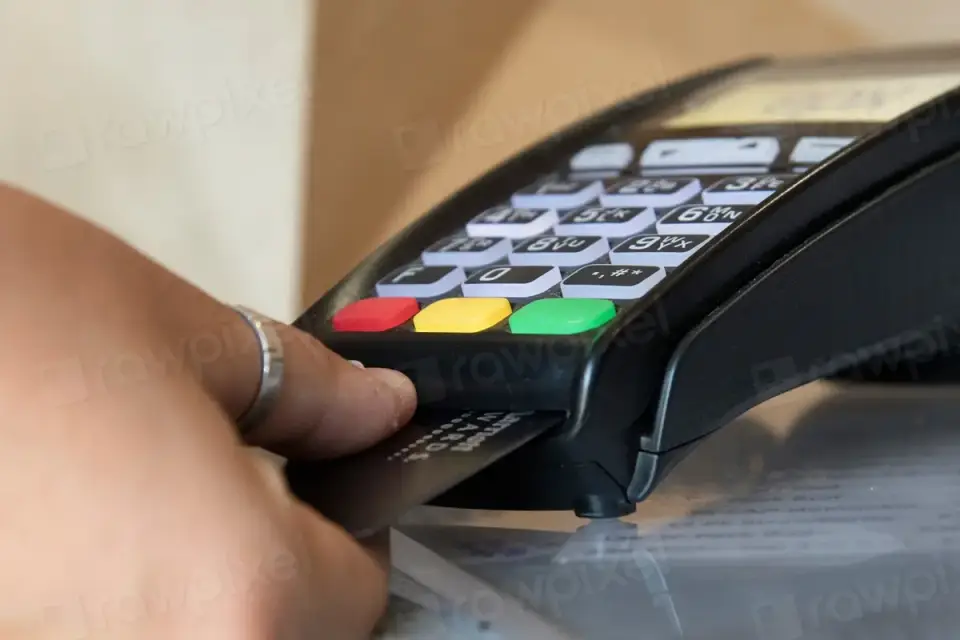
6. Cash isn't free either
It's tempting to treat cash as the costless option next to a 1.9% card rate, but that's only true if you value your team's time at nothing. Counting cash — the till at open and close, preparing a bank deposit, double-checking when it doesn't add up — costs minutes per shift, every shift, from someone who's doing nothing else during those minutes.
On a restaurant taking €735 a week in cash, where someone spends 25 minutes a day on it at an all-in staff cost of €16.80 an hour, that's roughly €49 a week in time — nearly €2,548 a year, or about 6.7% of what actually comes in as cash. That's higher than the card rate you saw in step one, and it never appears on any report because it's never booked as a cost line — it's just time that gets "absorbed".
That isn't an argument for refusing cash altogether — some guests have no other option, and a restaurant with no cash option shuts them out. It is an argument for making the comparison honestly: cash isn't free just because it has no percentage attached, it's a cost you pay in time instead of euros. If you want to track it systematically alongside the rest of your daily takings, our daily cash-up tool is built for exactly that.
7. The negotiation: what to ask for, and what switching is actually worth
Now that you know which three layers are negotiable, the conversation with your processor comes down to four concrete questions: can you move to interchange-plus instead of blended pricing? What exactly is your markup on top of interchange? Can Dynamic Currency Conversion be switched off by default? And what's the real settlement time into my account? A processor that answers all four clearly is usually also one with little to hide in its margin.
Work out beforehand what a cut is worth, so you know how much negotiating time it deserves: on annual card revenue of €207,480, every 0.3 percentage points you get shaved off your rate is worth roughly €622 a year — without changing your service, your menu or your prices. That's half an hour on the phone once a year, for money that would otherwise just keep going to your processor.
The same logic that applies to negotiating with suppliers applies here: the first quote is never the best one, and switching usually doesn't mean replacing your POS system — most terminals work with several processors. Ask for a competing quote at least every two years, even when you're happy; processors rarely offer their best rate to an existing customer unprompted.
Work out your own card and cash costs
Enter what you take with card and with cash on an average week, your current blended rate, and how much time cash counting costs you. The figures are pre-filled for a restaurant taking €3,990 a week by card and €735 by cash, at a 1.9% rate, so you can see how it reads straight away — then overwrite them with your own.
You'll get your rate against a healthy benchmark, what card and cash together cost you a year, and what a 0.3-percentage-point cut would actually be worth.
Payment cost scan
Your card revenue, your cash revenue, your rate and your cash-handling time — into one annual figure.
—
The band is a benchmark for independently run European restaurants and doesn't account for your concept, your guest mix or your negotiating position. Everything runs in your browser; nothing is sent or stored.
Two things worth remembering as you read this. Your blended rate is never one indivisible number — it's interchange plus scheme fee plus acquirer margin plus gateway cost, and only the acquirer margin is genuinely negotiable. And cash isn't a free alternative: it just never shows up on a report, which is a different thing from being free.
Both cost lines get fixed the same way as the other leaks on this site: you have to see them before you can act on them. Ask for your statement, set aside time for it once a year, and treat it with the same seriousness as the pour cost and food cost you already know to the cent.
What to do this week, this month and this quarter
Nobody tackles all four layers in one conversation. This order works, because each step makes the next conversation more concrete.
This week — ask for the breakdown
- Ask your processor for an interchange-plus statement, even if you're currently on blended pricing — you don't have to switch yet to see what's inside your rate.
- Ask explicitly whether Dynamic Currency Conversion defaults to on at your terminal, and switch it off if it does.
- Fill in the scan above with your own revenue and rate, so you have a concrete annual figure to take into the conversation.
This month — compare and negotiate
- Get at least one competing quote from another processor, even if you're happy — your current one rarely offers its best rate unprompted.
- Ask for the exact settlement timeline into your account, and whether a faster schedule is available.
- Measure, for one week, how much time cash counting actually costs your team, instead of estimating it.
This quarter — make it stick
- Put an annual review of your payment costs in your calendar, alongside your other supplier negotiations.
- Decide who counts the cash and how long it's allowed to take, so it doesn't stay a cost that creeps up unnoticed.
- Set this scan alongside your prime cost — what processing and cash time cost you belongs in the same yearly conversation as your pour cost and food cost.
One percentage, four decisions
Almost every restaurant that unpacks this for the first time finds the same thing: there's no unfair processor and no hidden fraud, just a rate that was never split apart because nobody ever asked. Interchange is fixed by law. The other three layers are each a choice — your processor's, or yours, the moment you have the conversation.
One statement requested, one question about Dynamic Currency Conversion, one competing quote a year — that's the whole recipe, and it's usually worth a few hundred to a few thousand euros a year, depending on your card revenue.
Then do the same with the rest of your P&L. Our guide to drinks margin and pour loss unpacks exactly the same kind of invisible cost on the other side of your restaurant, and together with your prime cost they give you the full picture of what's actually left at the end of the year.