

In this article
You can change your menu, retrain your staff, raise your prices and redesign your interior. But there is one decision you can barely undo: your location. That is why choosing your premises is the most decisive — and most underestimated — investment decision you make as a restaurateur. The wrong location drags a strong concept down for years; the right one gives even an average venue a structural head start.
The problem is that most operators fall in love with a unit before they have seen the numbers. The corner unit with tall windows, the south-facing terrace, the charming façade — it feels good. But "feeling good" is not a location strategy. A location that is structurally too expensive, too hard to see, or a poor match for your target audience is charged back against your cash flow month after month.
This article gives you 9 factors to assess a location objectively before you sign: from measuring footfall and the crucial rent-to-revenue ratio to permits, fit-out costs and the lease. By the end you will have a scorecard you can use to compare any unit on the things that really decide your revenue — not on your gut feeling.
Start with your concept, not with the unit
The biggest mistake in choosing a location is to reverse the order. Many operators first look for a nice unit and then work out which concept fits inside it. That is back to front. The right order is: first define your concept and your ideal guest, then look for the location that suits them.
A fine-dining venue with an average spend of €120 per head needs a completely different location than a fast lunch spot that runs on volume. The first needs a destination — guests travel there on purpose and a quieter street with parking can be perfect. The second needs footfall — a busy shopping street or office district where people drop in spontaneously. The same location can be gold for one concept and fatal for another.
So before you start searching, pin down: who is your guest, what is your average spend, how many covers do you need per service to be profitable, and at which times of day do you make your money? Those answers — which you also need for your business plan — are the lens through which you judge every location.
Factor 1: Measure footfall and traffic flow
For many concepts, footfall is the engine of spontaneous revenue. But "a busy street" is not a measurement. Go and count it yourself. Stand outside the unit on different days and at different times and count the number of passers-by per quarter hour — at a weekday lunch, a Friday evening, a Saturday afternoon.
What you are looking for is not just volume, but the right passer-by at the right moment. An office district buzzes between noon and 2pm and is dead at the weekend. A shopping street peaks on Saturday. A nightlife district only comes to life after 8pm. Match those rhythms to the moments when your concept makes money. An evening restaurant in a pure office zone counts thousands of passers-by during the day who are nowhere to be seen at night.
- Count in time blocks: record passers-by per quarter hour on at least three different parts of the day and two different days.
- Watch direction and pace: people hurrying to the station don't stop for dinner. People strolling and shopping do.
- Look for "anchors" nearby: a cinema, theatre, supermarket or busy square draws people in consistently and feeds your venue too.
Factor 2: Match the demographics to your target audience
Footfall without the right profiles is empty traffic. A neighbourhood full of students is gold for an affordable concept and poison for a fine-dining venue. Research the catchment area — typically the area within 10 minutes' walk or drive, because that is where the vast majority of your guests come from.
A lot of information is free to look up through national and local statistics offices and council data: average income, age structure, household composition, the share of tourists, and the density of offices and homes. On top of that, walk the area at different times. Which other venues are doing well here? Who is sitting on the terrace? That tells you more than any spreadsheet.
The question is simple: does your ideal guest live and move here, and can and will they pay your average spend? If the answer is no, no amount of marketing fixes it — you would be trading against the neighbourhood every single day.
Factor 3: The rent-to-revenue ratio — the most important sum you'll do
This is where most restaurants come unstuck. Not because of bad food, but because of a rent that is structurally too high for the revenue the unit can generate. The hospitality rule of thumb is clear: your total occupancy costs (rent plus service charges) should sit between 6 and 10% of your annual revenue.
Below 6% you have an excellent deal. Between 6 and 10% is healthy. Above 10% the rent becomes a permanent drag on your profit, and above 12% a venue is unsustainable in the long run in most cases — every euro that goes to the landlord can't go to staff, quality or your buffer.
Always work backwards, not forwards. Don't start from the asking rent, but from a realistic revenue forecast for this specific location. Say you expect €600,000 in revenue per year here. Then your healthy rent ceiling is 6–10% of that, i.e. €36,000 to €60,000 per year — €3,000 to €5,000 per month. Is the landlord asking €7,000? Then the unit is too expensive for the revenue it realistically delivers, however lovely it is. Walk away, or negotiate hard.
Don't forget the additional fixed charges that affect whether a unit is liveable: energy costs, property tax, insurance and maintenance. A cheap unit with sky-high energy and maintenance bills is not cheap.
Factor 4: Visibility and findability
A restaurant nobody sees doesn't exist as far as passers-by are concerned. Visibility has two dimensions: physical and digital.
Physical visibility is about so-called "curb appeal": can you see the unit from a distance, is the frontage wide enough for recognisable signage, is it on a corner (a double sightline), and does the shopfront invite people to look inside? A unit hidden behind a tree, a bus shelter or a bend pays for it every day. Tall windows and an open frontage are free advertising.
Digital visibility has become at least as important. Most guests "see" your restaurant for the first time on Google Maps or via a search, not from the pavement. A findable address in an area where people actively search for restaurants is a form of visibility in its own right. Make sure your location is right from day one on your restaurant website and in your Google Business Profile — that digital findability partly compensates for a less prominent physical position.
Factor 5: Accessibility and parking
The easier it is for guests to reach you, the larger your catchment area. Assess a location on every way people get there:
- Car and parking: for a destination restaurant outside the centre, parking is often decisive. Is there free parking, paid parking, or do guests have to look a street away? Parking stress costs you reservations.
- Public transport: proximity to a station, tram or bus stop widens your reach, especially in cities and for evening guests who want to drink.
- Bike and on foot: in city centres a growing share of guests arrive by bike. Safe parking facilities count.
- Access for deliveries: can lorries load and unload? An impossible delivery setup makes your inventory management more expensive and more stressful every day.
Factor 6: Competition — cluster or go solo?
Many operators think you should stay away from competitors. Often the opposite is true. A street or square with lots of restaurants — a "restaurant row" — consistently draws people who come out to choose where to eat. That anchor effect fills your venue too. Sitting next to peers is therefore rarely a problem, as long as you stand out with your concept.
What you should map out:
- Direct overlap: if there are already three Italians in the same street, a fourth is a fight. A different offer on the same dining street is actually an opportunity.
- The level of the neighbourhood: are the surrounding venues doing well and sitting full? That proves the location can carry revenue. Lots of empty units and a churn of operators are a red flag.
- The "tenant before you": why did the previous operator leave? A unit where three concepts in a row went bust tells you something about the location, not just about the operators.
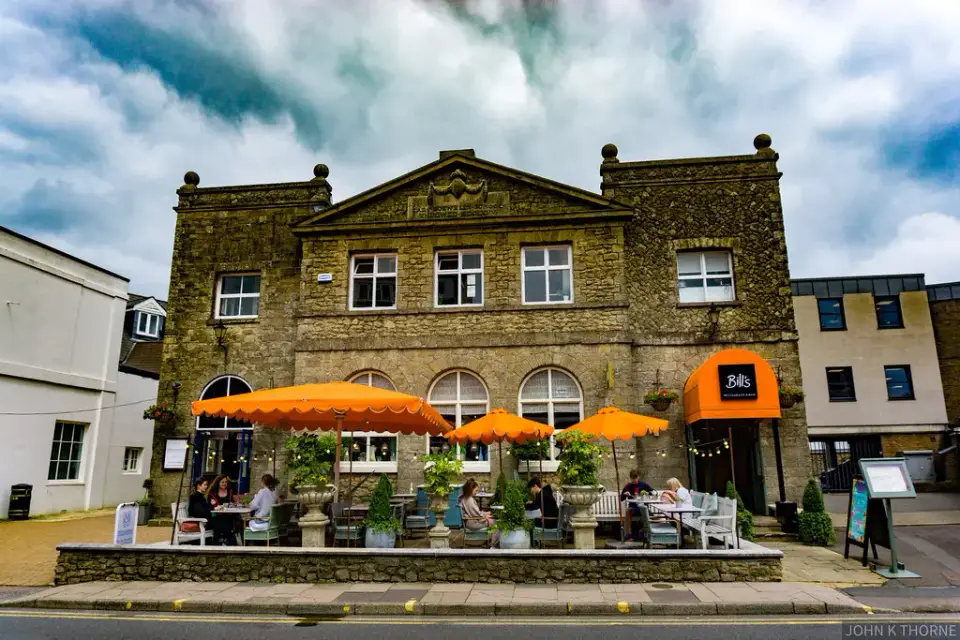
Factor 7: Permits, zoning and terrace
A perfect location is worthless if you aren't allowed to run what you want there. This is the boring but deal-defining part: check the permit situation before you sign, not after.
- Hospitality use class: does the unit have the right use class for a restaurant with a kitchen? A change of use from retail to hospitality is not always permitted and can take months.
- Terrace permit: a terrace is worth its weight in gold for revenue in many concepts. But is it allowed, how big, and until what time? Never count a terrace into your revenue in advance if the permit isn't secured.
- Noise, smell and extraction: homes above or next to you? Complaints about smell and noise can limit your opening hours and kitchen options.
- Opening hours: some zones have restrictions on closing time. Check that they fit your concept and your planned opening hours.
Factor 8: The state of the unit and the fit-out cost
Two units with the same rent can be tens of thousands of euros apart once you look at the fit-out. A unit that already has a commercial kitchen, extraction, a grease trap and enough electricity and water saves you a fortune compared with an empty shell you have to build out entirely.
- Technical base: are there enough power circuits, a gas supply, water and drainage, and existing professional extraction? These are the most expensive items to install after the fact.
- Kitchen and infrastructure: taking over a working kitchen can save an investment of tens of thousands of euros.
- Factor the fit-out into your returns: spread the one-off fit-out cost over the term of your lease. A low rent in a shell that needs €150,000 of work may be more expensive than a higher rent in a turnkey unit. Build this into your ROI calculation.
- 2026 compliance note: in your cost estimate, allow for technical obligations such as a registered cash register system — a one-off investment you should include in your opening budget.
Factor 9: Negotiate the lease
The asking rent is a starting point, not a final figure. The lease is where you can win or lose a lot of value — often more than in the rent itself. Always have a commercial lease reviewed by a specialist, and watch these levers:
- Rent-free period: ask for a few months rent-free during your fit-out and start-up. You don't pay full rent for a venue that isn't trading yet. This is one of the most underestimated negotiating points.
- Term and break option: a long term gives security but ties you in. Negotiate an interim break option in case the concept doesn't take off.
- Indexation: know how and when the rent is indexed each year, and cap it where you can. Uncapped indexation can wreck your healthy ratio within a few years.
- Maintenance and charges: set out clearly who bears which costs (roof, building services, façade). Unexpected maintenance charges undermine your break-even.
- Goodwill and key money: are you paying a fee to take over an existing business? Make sure it is in proportion to what you really take over (customer base, fit-out, permits).
Build a location scorecard
Falling in love with a unit is human, but your decision should be objective. Build a simple scorecard: line up the 9 factors, give each unit a score from 1 to 5 per factor, and weight the factors that matter most for your concept (for a lunch spot, footfall weighs more heavily; for fine dining, parking and atmosphere weigh more).
That way you never compare one unit in isolation, but at least two or three against each other. Only then do you see which location really has the best credentials — and you can negotiate with figures in hand instead of signing with your heart.
Conclusion: location is a calculation, not love at first sight
Choosing the right location is the most strategic decision you make, because it's the only one you can barely correct later. Start with your concept and target audience, measure footfall and demographics objectively, and let the rent-to-revenue ratio be your guide: 6 to 10% of a realistic revenue, no more. Check permits and fit-out costs before you sign, and negotiate the lease as if your profit depends on it — because it does.
Get this right and you give every concept that goes inside a structural head start. Combine a strong location with sharp budget management and healthy financing, and you lay a foundation that lasts for years. Then use restaurant analytics to prove what you suspected: that the right spot, at the right moments, sits full.