

In this article
- The first bite: why the amuse-bouche is your true opening line
- 1. Treat the amuse-bouche as a gift, not an obligation
- 2. Make the amuse-bouche the signature of your kitchen
- 3. Build your margin from kitchen trim
- 4. Align the amuse-bouche with the menu and the season
- 5. Manage the allergen risk of a bite nobody ordered
The amuse-bouche is the only course your guest did not order, did not choose and did not pay for — and that is precisely why it is your strongest trust signal. While the guest is still making up their mind and lifting their first glass, a small, considered bite appears on the table, uninvited: a gift from the kitchen. No other course carries that power. And yet most restaurants treat the amuse-bouche as a perfunctory gesture — a quick toast, the same every night — rather than the strategic act it can be.
That is a missed opportunity at its sharpest. The amuse-bouche stands at the intersection of three things every fine-dining restaurant should be chasing: an unexpected gesture of generosity that instantly builds trust, a statement that shows in one bite who you are as a kitchen, and the dish with by far the highest ratio of perceived value to cost on your entire menu. Handled well, the amuse-bouche is one of those rare investments that lift your reputation, your hospitality and your profitability all at once — before the first paid course has even reached the table.
In this article we treat the amuse-bouche the way a top establishment should: as the deliberate opening line of the menu. In seven concrete steps — from the psychology of the gift, through the amuse-bouche as the signature of your kitchen, the margin you extract from kitchen trim, alignment with the menu and the season, the allergen risk, presentation and timing, to training your brigade and the hard arithmetic of profitability.
The first bite: why the amuse-bouche is your true opening line
In gastronomy there is a psychological law that ought to steer your entire service: the first moments of an experience weigh disproportionately heavily. Where the peak-end rule teaches that the end of a dinner — the coffee and the last sip — sticks in memory, the primacy or anchoring effect teaches that the beginning sets the bar against which the guest measures everything that follows. People form a judgement within a few minutes — a swift "thin slice" — and from then on unconsciously interpret everything that comes next in the light of that first impression.
The amuse-bouche is, literally, that first bite. And it carries a second, even more powerful layer: it is a gift. Nobody asked for it, nobody pays for it. In doing so, the amuse-bouche activates the reciprocity principle — one of the best-documented mechanisms in behavioural psychology: whoever receives something unexpected and genuine feels seen and is inclined to respond with warmth, trust and generosity. The guest welcomed with a beautifully crafted little bite is already relaxed, valued and well-disposed at the table, before the first order has been placed.
Precisely because so few restaurants consciously direct the amuse-bouche, an establishment that does stands out immediately. Together with the aperitif moment and the bread service, the amuse-bouche forms the first impression of your guest experience — the overture that carries the whole evening.
1. Treat the amuse-bouche as a gift, not an obligation
The first step is a mindset. The moment the amuse-bouche becomes a habit — "we just put something down as standard" — it loses its magic. A gift only works if it also feels like a gift: made with intention, presented with care, and announced with a single sentence from the floor ("With the compliments of the chef: a spring variation on pea and mint"). That one sentence turns a bite into a gesture.
So do not treat the amuse-bouche as a leftover or a filler, but as a deliberate creation that carries your signature. It is the opposite of pushiness: no selling, but genuine generosity — and it is precisely that generosity that makes it the most hospitable moment of the evening. It is the same spirit that ought to run through your entire service excellence.
2. Make the amuse-bouche the signature of your kitchen
The second step is content. The amuse-bouche is the ideal place for a thesis: one bite that tells, in concentrated form, who you are as a kitchen. Do you work with local produce and seasonality? Let the amuse-bouche shout that. Does your kitchen revolve around fermentation, fire, Japanese precision or classic French technique? Then this is the first — and sharpest — proof of that.
A strong amuse-bouche is also marketing gold: a surprising, beautifully presented bite is exactly the kind of detail guests photograph, share and remember. Keep it small and considered: one clear flavour or a clean contrast, executed perfectly, says more than a mini-plate with seven elements. The amuse-bouche should connect seamlessly to the plate presentation and the tone of your tasting menu.
3. Build your margin from kitchen trim
The third step is where psychology and economics meet. The amuse-bouche has the highest ratio of perceived value to food cost of anything on your menu. A guest easily experiences a carefully crafted bite as an attention worth several euros — while you, built smartly, make it for a few tens of cents.
The secret is kitchen trim: the high-quality "offcuts" that in most kitchens end up in the bin. The outer leaves, the fish trimmings, the prawn heads for a bisque espuma, the herb stalks for an oil, the core of the vegetable, yesterday's stock. An amuse-bouche from trim is a double win: you reduce your food waste and your food costs, and at the same time deliver a generous-looking gesture. So the cheapest part of your purchasing becomes the most impressive moment of the evening.
The secret of the amuse-bouche: cost versus value
One bite, built from kitchen trim — minimal cost, maximum impression
And that is before considering what the amuse-bouche pulls along with it. A guest who feels generously treated from the very first bite is more likely to opt for the full menu, quicker to order an extra bottle and more likely to leave a top review. The amuse-bouche, like dessert and coffee, is a course where the returns can be improved almost for free — and, on top of that, the only one that builds the trust for everything that is ordered after it.
4. Align the amuse-bouche with the menu and the season
The fourth step turns the amuse-bouche into a bridge. A bite that points ahead in flavour, season or theme to what is coming builds anticipation and gives the whole menu coherence. A briny amuse-bouche that announces the sea, a bitter note that asks you to trust, a hint of the evening's main ingredient: in this way the first bite becomes a promise that the rest of the dinner delivers on.
Let the amuse-bouche therefore move with your seasonal menu and change it regularly. An amuse-bouche that stays the same for months betrays a kitchen running on autopilot; one that breathes with the season tells your regulars something new every time. Align it with the aperitif too: a bite that pairs beautifully with the first glass — something salty alongside a dry bubble — is in fact your first pairing of the evening.
Want to design your tasting and menu cards professionally? Use our free menu maker — pick a template, adjust colours and fonts and export your menu, with the amuse-bouche as its generous opener, to PDF in a single click. No account needed.
5. Manage the allergen risk of a bite nobody ordered
The fifth step is one most restaurants overlook — and it is the difference between a gesture and an incident. Because the guest does not order the amuse-bouche themselves, an unannounced bite can take someone with an allergy or dietary need completely by surprise. A guest who has carefully ordered gluten-free or nut-free will logically assume that the "free" bite appearing uninvited is also safe. That is precisely where things go wrong.
So make the amuse-bouche a fixed part of your allergen management: check allergies at the reservation and at the table before the amuse-bouche goes out to the dining room, record them in the guest profile, and always keep a safe, equally polished alternative amuse-bouche on hand — vegetarian, gluten-free, nut-free, alcohol-free. A guest who sees that even the gift has been tailored to their restriction feels truly looked after. A "free" bite must never become a liability.
6. Direct the presentation and the timing
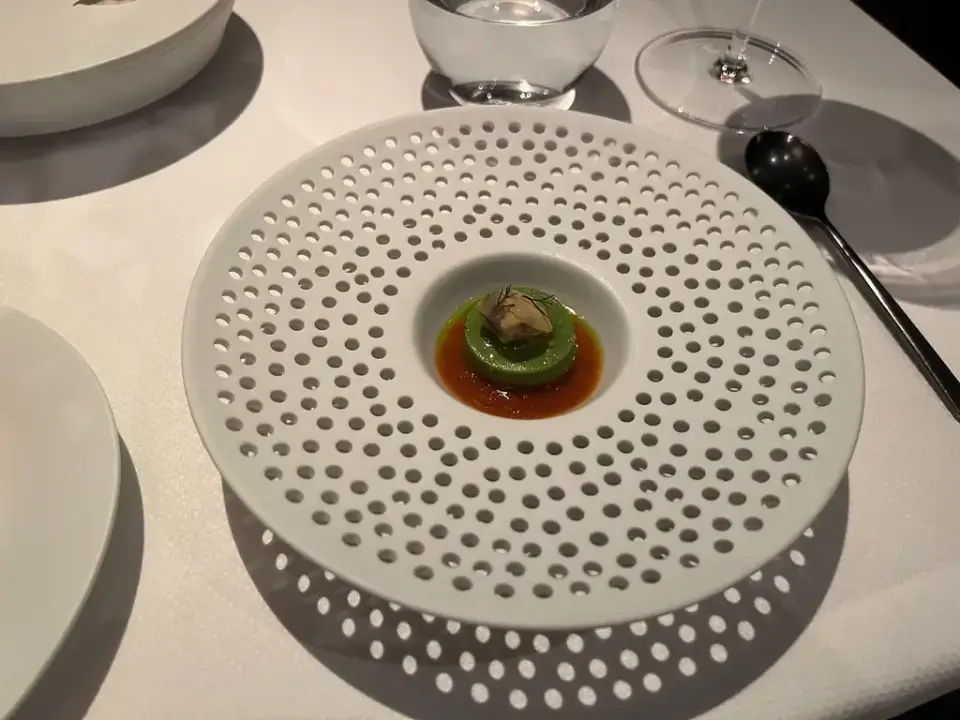
The sixth step is direction. An amuse-bouche is a small piece of theatre: the vessel matters. A bite on an elegant spoon, a smoked plate under a cloche lifted tableside, a warm amuse-bouche finished at the last moment — it turns a bite into a moment. It is the same principle as a preparation at the gueridon: the aroma, the gesture and the anticipation become part of the multisensory experience.
One iron rule: the amuse-bouche must be eaten in one, at most two, bites — perfectly balanced in that single mouthful. Nobody wants to cut a "free" bite or share it in pieces. And the timing is just as important as the content: the amuse-bouche belongs shortly after the guests are seated and the aperitif has been served, while the kitchen is building the first course. Well timed, the amuse-bouche bridges exactly the wait and keeps the energy at the table high — just as good peak-hour management makes the difference between a flowing and a faltering start.
7. Train your brigade and calculate the returns
The seventh step decides whether everything above actually works: your team — in the kitchen and in the dining room. An amuse-bouche must be delivered to hundreds of guests identically, perfectly and quickly without delaying the first course. That demands tight mise-en-place: prepared components, a fixed finishing point, a clear pass. And it demands a floor team that can place the bite with a few words — what it is, why it is there — so the gift also reads as a gift.
So make the amuse-bouche a fixed part of your staff training and internal tastings: a team that has tasted the amuse-bouche themselves and knows the story delivers it with conviction. Then calculate the returns. The amuse-bouche does not appear separately on the bill, but its impact is real and measurable — just as with your broader menu engineering:
- Food cost: built from trim, an amuse-bouche often costs you just €0.30–€0.60 per guest — a fraction of every other course.
- Higher take-rate of the tasting menu: a generous, convincing opener lowers the threshold to the full (and more expensive) menu.
- More drinks and wine revenue: a relaxed, well-disposed guest orders an extra glass or bottle more readily.
- Better reviews and return visits: the "free" attention is precisely what guests spontaneously mention and share.
No other course with a food cost of a few tens of cents moves so much. That makes the amuse-bouche, when consciously directed, one of the cheapest levers in your entire establishment.
An extra amuse-bouche course demands tight staffing. Plan your kitchen and floor team around the extra mise-en-place and the pass with our free staff schedule maker — drag shifts, see coverage instantly and share the rota in a single click. No account needed.
Integrate the amuse-bouche into your guest and loyalty strategy
The amuse-bouche deserves a place beyond the plate. Just as you personalise the welcome, you can also tailor the gift. Do you know that a regular loves sea flavours, is vegetarian or is celebrating a birthday? Record it in their guest profile and let the kitchen craft an amuse-bouche around it. Nothing binds a guest as personally as a bite that was clearly thought up for them — a small gesture that nourishes their loyalty and gives them a story to pass on.
A surprising, generous amuse-bouche is exactly the kind of detail guests mention in reviews and describe to friends. It strengthens your whole experience and gives new guests a reason to choose you. The beginning of the evening is, after all, the moment when the guest decides how they will tell the story of their experience.
Conclusion: write the first bite that carries the whole evening
The amuse-bouche, handled correctly, is one of those rare places in your restaurant where psychology and economics reinforce each other. It is literally your first bite — the gift that wins trust and sets the bar for everything that follows — and the dish with the highest value-to-cost ratio on your entire menu. And yet almost everyone leaves it on the table, which instantly makes it your easiest way to stand out.
So do not treat your amuse-bouche as a perfunctory toast, but as a directed gift: make it with intention, let it represent your kitchen, build your margin from trim, align it with the menu and the season, manage the allergen risk, direct the presentation and the timing, and train your brigade to deliver it perfectly and generously.
The guest welcomed with an unexpected, generous bite does not remember the average of their evening — they remember how it began. And that beginning is yours to write. Turn your amuse-bouche, your aperitif and your coffee into one coherent arc from the first to the last bite, and you turn the opening minutes of dinner into your most powerful sales and hospitality instrument.